



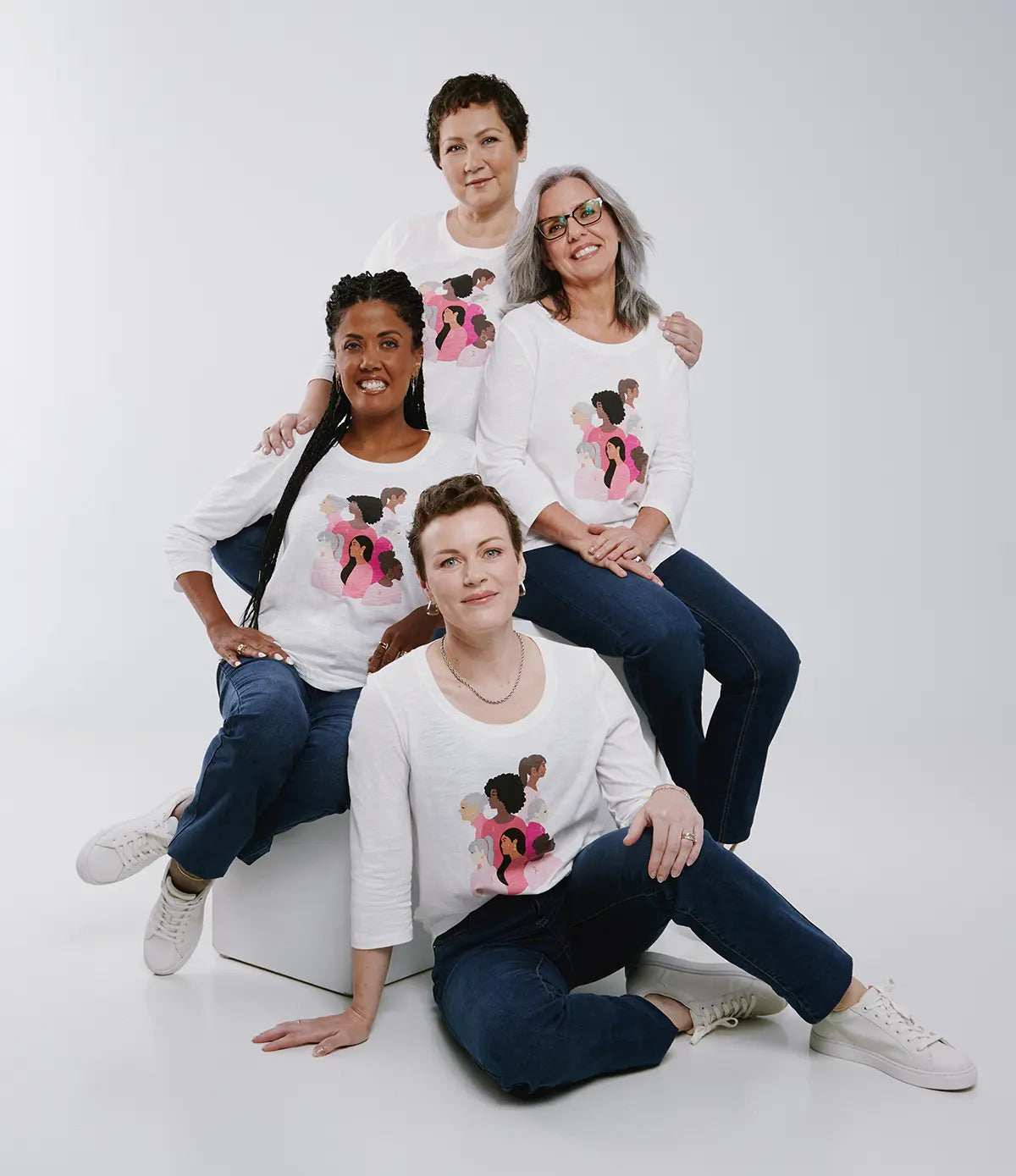


BONNIE WALKER
MOTHER OF TWO | DIAGNOSED AT 55
I focused on controlling what I could control.
One in eight women will receive a breast cancer diagnosis within their lifetime. We don’t control whether we’re going to be number eight or not. We don’t control the diagnosis. But we do control how we deal with it.
I realized early on that I didn’t have a lot of control over the whole medical aspect of it, but that I could control how I was going to deal with it. Was I going to cry in a corner, or was I going to say, “Let’s frigging get this done and move on.” I knew what was right for me – I was always about just getting it done. I approached my breast cancer diagnosis like a job that I had to complete. I didn’t want to feel like a victim. I was going to be a survivor, and that was that.
I’ve always been a black-and-white type of person. I’m very factual and pragmatic. Give me the statistics, the numbers, the probabilities – I need to be informed so I got busy getting informed. I wanted to understand the tests I was undergoing, the different types of breast cancer, my treatment options, genomic testing, and on and on. Again, I approached it like a project that needed to be done. I had a squatter in my body and I needed to get rid of it. So even losing my hair, losing my nails, losing my breasts – I didn’t find it that challenging, personally. For me, it was getting the job done.
And listen, breast cancer is very common. My number came up, plain and simple. Knowing the numbers, the one-in-eight statistic, I realized that I wasn’t the first, I wasn’t going to be the last, and I wasn’t alone. This is something that many people go through. And the science, research, and advancements in treatments are incredible. I never looked at it as a death sentence – just as something that needed to be taken care of.
I approach my whole life this way – with a black-and-white, factual perspective. Some people are emotional beings and others are logical beings, and I simply tend to be more logical. I always say, control what’s in your control and know what isn’t in your control. There’s no point trying to control something that’s out of our control. We’ll just drive ourselves crazy. I’ve had a long corporate career in the travel industry, and now that I’m finished treatment, I’m back at work. I needed to find “me” again, and “me” is not a patient. I was able to prove to myself more than anyone else that the old Bonnie was still there and could still lead a team. In my career, I’ve always been a team leader – I really enjoy developing a team and coaching them. The idea of “controlling what’s in your control” is something that I learned at work. As a leader, I can ask people to do something and generally they will – most people want to do a good job. But things fall through the cracks, people have bad days – and I can coach them, but I can’t demand or control, because it’s not my actions we’re talking about, it’s somebody else’s. That goes for everything. I could ask my daughter to put away her clothes, but I can’t make her. And so however they respond, whatever they do – I have a choice in how I react to that, but I don’t have control over it.
There are things in life I can control – how I reacted to my diagnosis, how I took care of myself, how I showed up every day, my attitude. How I looked and felt leaving the house – I could look frumpy and feel frumpy, or I could put on some eyeliner and have more confidence attacking the day. I could focus on staying in the moment and tackling my treatment plan one step at atime.
From the moment I got my diagnosis, I told my daughters that this is happening for a reason – and that something will have to come from it. If I can help one person through their journey, then maybe that’s my reason. It may not be a black-and-white answer. It may be something that comes in stages. I’m a very logical person so I look for that black and white, but I’m also open to all of that grey area in between.


